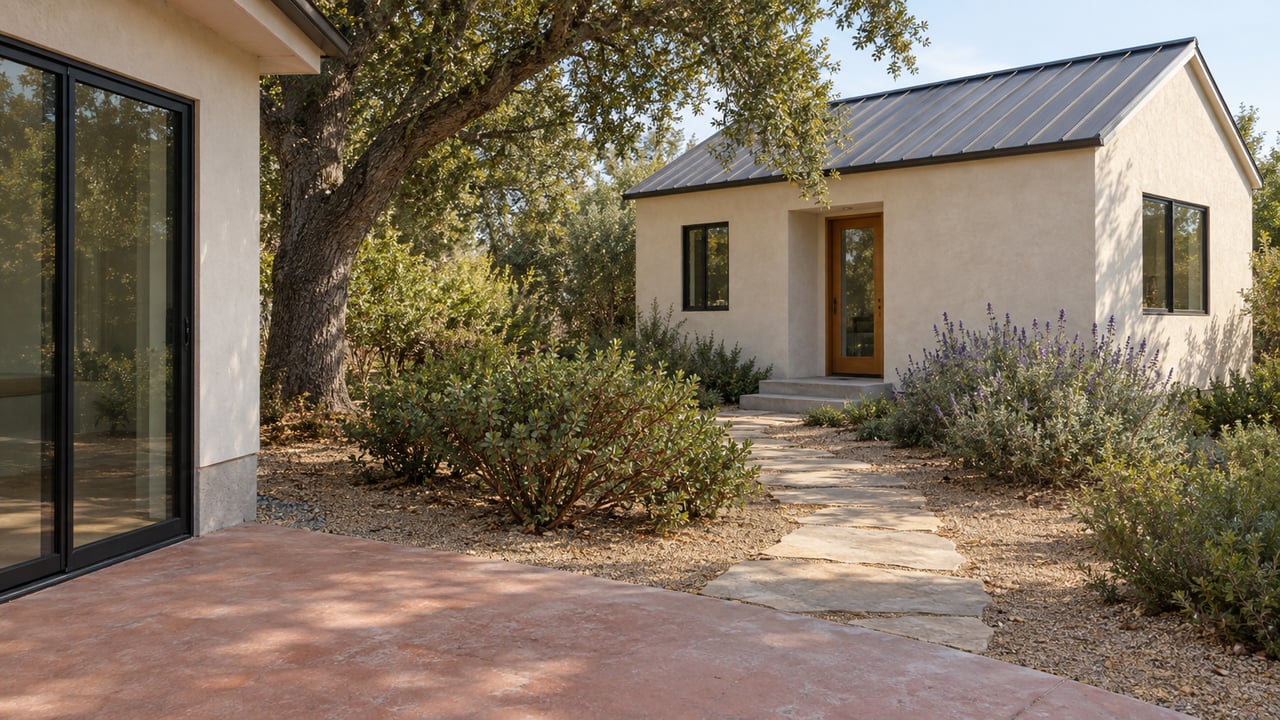
Scroll far enough through Almaden Valley listings this fall and you'll hit something that reads strangely if you don't know what you're looking at. A single street address in the 95120 ZIP code, listed as a condominium, priced well under the neighborhood's typical single-family range, sitting on a lot that public records show belongs to a house built decades earlier. It isn't a data error. It's a backyard cottage, sold off on its own, while the original house next to it stays right where it's always been, owned by the same family, taxed at the same rate it's been taxed at for years.
That listing is the leading edge of something new in Almaden Valley, and it's worth understanding before you write an offer or plan a sale, because it's starting to change what "inventory" actually means in this ZIP code.
The Tax Bill That Keeps The For-Sale Sign Down
Almaden Valley's single-family market has run tight for a long stretch, and the reason isn't only that people like living there. California's Proposition 13 caps how much a property's assessed value can rise each year, at roughly 2 percent, no matter what the house is actually worth on the open market. That assessment only resets to full market value when a property changes hands or undergoes significant new construction.
Consider a homeowner who bought a house in San Jose back in 1990 for $200,000. Three and a half decades of the 2 percent annual cap later, that same house might carry an assessed value well below its market value, generating a lower property tax bill, according to the Santa Clara County Assessor's own explanation of how base year values work. If that homeowner sold and bought a comparably priced replacement today, at something closer to $1.5 million, the DiVita Home Finance estimate puts the new tax bill at roughly $16,500 a year. That means a higher annual tax bill for staying in the same market, in the same house type, on the same amount of land.
For an owner sitting on that math, selling doesn't look like a financial win. It looks like a tax penalty for moving. Housing economists have documented this "lock-in effect" across California for years, and it's one of the quiet forces behind chronic inventory shortages in long-established neighborhoods.
How Tight Almaden's Market Already Is
Almaden Valley is a textbook example. The single-family segment here has run in a low-inventory, high-demand pattern for years running, not months. As of February 2026, homes in Almaden Valley were selling in around 12 days on average and drawing roughly 6 offers per listing, even as the median sale price eased to about $2.0 million, down 13.2 percent from the year before, and the median price per square foot came in near $922. Prices softened. Speed and competition didn't.
That combination, falling prices and still-fast sales, is what you'd expect in a market where the supply problem is structural rather than cyclical. Buyers aren't short on interest. Sellers are short on reasons to list.
The New Escape Hatch
In June 2024, San Jose's City Council approved a zoning update, filed as PP23-007, that did something no other California city had done yet. The city's own description of the change is direct:
"San Jose is the first city in California to implement the law that enables the sale of ADU condominiums."
The ordinance, recorded as Ordinance No. 31095 and effective July 18, 2024, implements a state law known as AB 1033. Under it, a homeowner who has built a permitted accessory dwelling unit can convert that unit into its own condominium through an approved parcel map, and then sell it separately from the main house. The ADU gets its own title. The buyer gets a standalone piece of ownership. The Santa Clara County Assessor explains that when new construction is added, a base year value is established for the new portion only; the base year value for existing improvements that were not changed remains the same.
Why It Lands Hardest On A Third Of An Acre
This matters more in Almaden Valley than almost anywhere else in San Jose, because the ordinance depends on something Almaden has in unusual supply: room. According to Generation Builders USA, detached ADUs in San Jose can run up to 1,200 square feet, with setbacks as tight as 4 feet on the rear and sides, but they still need a backyard large enough to hold the structure and meet those setbacks without crowding the existing house.
Almaden Valley's subdivisions were largely built between the 1960s and the 1990s on generous lots, many around a third of an acre, with some parcels along Almaden Road and McKean Road running to multiple acres and dating back to the early 1900s. Oak Canyon, built out by Shea Homes around 1980, sits on lots commonly around 8,000 square feet and sometimes larger than a quarter acre. Crossgates, established in 1966 and still home to its original swim club, has held many of the same families for decades, which is exactly the kind of tenure where the Prop 13 gap between assessed value and market value grows widest.
None of that describes central San Jose's denser, newer construction, where lots are frequently too small to accommodate a detached unit that meets code. The ADU condo path is, in practice, a large-lot tool. Almaden Valley has the lots.
What This Means When You're Reading A Listing
If you're evaluating a property in Almaden Valley now, a few questions are worth asking before anything else:
- Is this listing the primary house, a standalone ADU condo unit, or a lot with an existing ADU that hasn't been mapped or sold separately yet?
- If it's an ADU condo, has the parcel map actually been recorded, with condominium documents and CC&Rs in place, or is the seller still mid-process?
- Is the property inside a homeowners association? Planned communities like California Ridge, structured as a Planned Development rather than a condo complex, and long-established HOAs like Crossgates are local examples worth checking.
- If the primary home carries a mortgage, has the lender consented to the parcel or condo map? Lenders generally need to sign off before a subdivision like this can proceed.
None of this changes the fundamentals of buying a house in Almaden Valley. It changes what you're comparing it to. A $1.4 million ADU condo unit and a $2.4 million single-family home on the same street aren't really competing for the same buyer, even though both will show up under the same ZIP code search.
The ZIP Code Isn't One Market
Almaden Valley's 95120 ZIP code has never priced as a single, uniform market, and the ADU condo path adds one more layer to that. School attendance boundaries already split the area in ways that matter to buyers: most of Almaden falls into the San Jose Unified district, with a northern section feeding Pioneer High and a southern section feeding Leland High, while a small pocket around Oak Canyon and Montevideo sits in the Campbell Union High School District, choosing between Leigh and Branham. Lot size correlates loosely with these pockets too, since the oldest, largest-lot subdivisions cluster toward the valley's southern and more remote sections, which is also where an ADU condo conversion is most physically feasible.
None of these factors work in isolation. A buyer comparing two Almaden Valley listings needs to know not just the price and the school boundary, but whether either property sits on a lot capable of the kind of split this new ordinance allows, because that capability is quietly becoming part of what the market is pricing in.
A Few Questions We Hear Often
Does building an ADU raise the taxes on my whole property? Under Prop 13's rules on new construction, the existing house keeps its base year value. Only the new ADU square footage is assessed at current construction value and added as a supplement. This is a general description of how the law works, not tax advice specific to your situation, and anyone considering this route should talk to the county assessor's office and a tax professional before proceeding.
Can any Almaden Valley property use the ADU condo process? No. It depends on lot size, setback compliance, HOA rules where applicable, lender consent if there's a mortgage on the primary home, and a completed parcel map with recorded condominium documents. Larger, older lots are better positioned than smaller, newer ones.
Does this mean more homes are about to hit the Almaden market? Not exactly. It's more likely to add standalone units to the market gradually, without necessarily increasing the number of full single-family houses for sale. The distinction matters when you're reading inventory numbers or comparing prices across listings.
If you're trying to figure out whether your Almaden Valley lot could support this kind of split, or you're comparing a listing that turns out to be an ADU condo against a full single-family home, it helps to talk it through with someone who tracks this market closely. Pauline and Jacob David can walk you through what your specific property or a specific listing actually represents, and help you get a clear read on what it's worth. Reach out for a free home valuation to start that conversation.