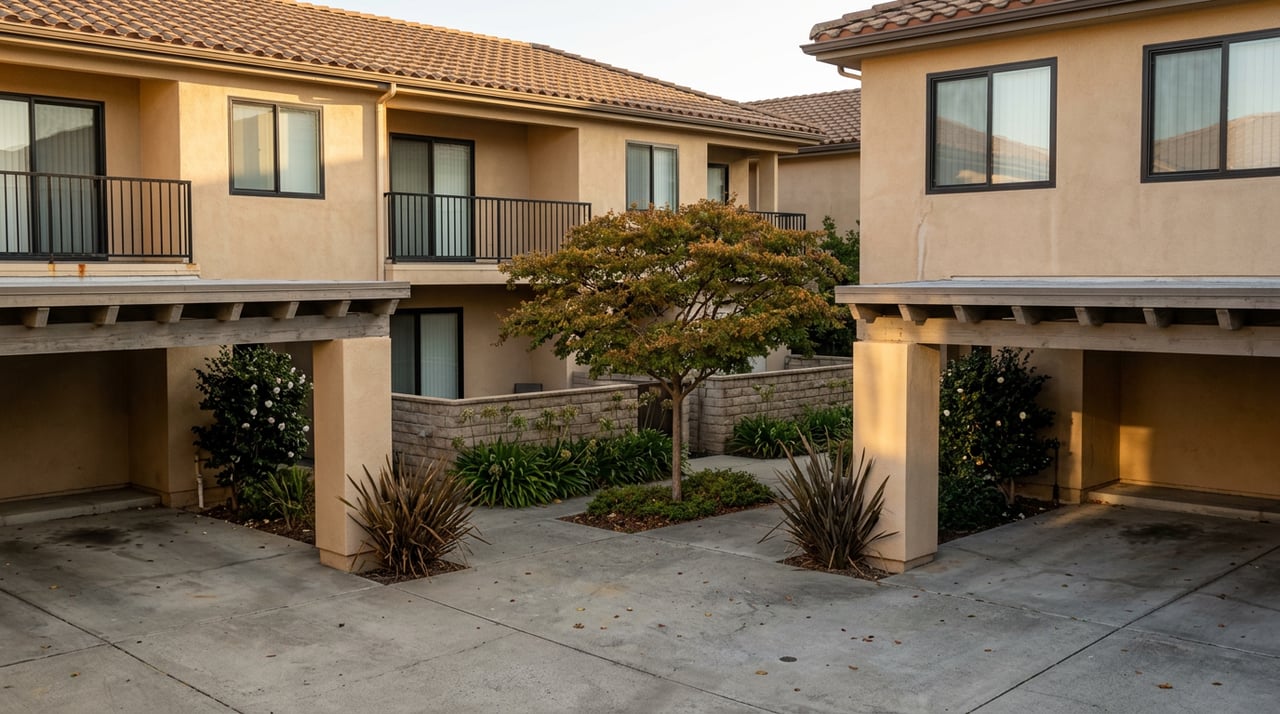
You find the listing photos first. Mature trees, a courtyard patio, a pool you can see from the kitchen window. The listing says two parking spaces included. You assume that means what it sounds like: two spaces that belong to the unit, the way a garage belongs to a single-family house.
In a good number of Blossom Valley's condo and townhome communities, that assumption is wrong, and the gap between what you assumed and what you actually bought does not usually surface until you try to sell, refinance, or settle a dispute with a neighbor over who gets the spot near the door. The word "included" on a listing sheet can mean three legally different things, and in a neighborhood built mostly in the 1970s, 1980s, and 1990s, which one applies to your unit is not always obvious from the listing or even from the HOA's own marketing.
Three Words That Sound The Same And Aren't
Real estate agents and title companies split condo parking into three categories, and the difference between them changes what you actually own.
A deeded space is real property. It is referenced in the original condominium declaration recorded with the county, tied to the unit's legal description, and in some cases carries its own parcel identifier separate from the unit itself. Because it is deeded, it transfers automatically when you sell, you can typically get title insurance that covers it specifically, and the homeowners association has very limited power to take it away or reassign it. Changing a deeded space usually requires amending the recorded declaration, which is a slow and deliberate process.
An assigned space is different. The HOA controls it. The board can reassign spaces, shrink the pool of available spots, or change the rules governing who gets what, sometimes without the current owner's consent, because the space was never legally attached to the unit in the first place.
A limited common element, or LCE, sits in between. You get exclusive use of the space, but it remains part of the association's common property rather than something you individually own. It is typically included in your regular HOA dues rather than taxed separately, but it is also more exposed to association decisions than a deeded space would be.
The practical test real estate attorneys point to is simple: if the space is deeded, it will have its own reference on the condominium map and often its own line in the property records. If it doesn't, you are looking at an assigned space or an LCE, and the association's rules, not your grant deed, govern what happens to it.
Why This Matters More In A 50-Year-Old Complex
Blossom Valley's attached-housing stock skews older than most of Silicon Valley's newer condo product. Several of the neighborhood's best-known communities date to the 1970s and 1990s, which means parking arrangements were often set up under an original developer's declaration decades ago and have sometimes been informally reshuffled by association boards since, without every change making it back into the recorded documents buyers rely on.
Consider the range of communities buyers compare when they shop this segment. Downer Estates, a 1970 community with 100 units near Westfield Oakridge and Highways 85 and 87, offers covered parking alongside its pool, spa, and tennis courts. Tanglewood, built in 1978 with 315 units, pairs mature landscaping and an Olympic-sized pool with a mix of two-car garages and private patios depending on the unit. Park Almaden, a 1995 community with 371 units near Almaden Lake Park, has listed in the high $700,000s and shows a mix of detached one-car garages, parking passes, and guest parking across its inventory, meaning two units in the same complex can carry genuinely different parking rights. Terrace Villas, by comparison, has shown pricing in the mid $400,000s to mid $500,000s, a meaningfully lower entry point that often comes with a more limited parking arrangement to match.
Four communities, four different ages, four different parking structures, all within the same zip codes and all marketed with similar language about pools, mature trees, and easy access to Highway 85 and 87. The amenity list looks interchangeable. The underlying property rights are not.
The Document That Actually Answers The Question
California does not leave this to guesswork, at least not in theory. Under the Davis-Stirling Common Interest Development Act, codified in Civil Code section 4525, a seller in a condo or HOA-governed sale must deliver a full disclosure packet before the buyer's contingency period runs out. That packet includes the CC&Rs, the bylaws, the operating rules, the current financial statements, any pending special assessments, and a statement on rental or age restrictions if they exist. The association has 10 calendar days from a written request to produce it, and once you receive it, California law gives you a short statutory window, typically a matter of days, to cancel the purchase agreement if something in those documents changes your calculus, even if you have already waived every other contingency in the deal.
As of January 1, 2026, that packet got one addition specifically relevant to a 1970s or 1980s complex with exterior walkways, balconies, or elevated decks. Following a 2019 state law requiring inspections of these elements, associations were required to complete their first inspection by January 1, 2025, and a follow-up law now folds the most recent inspection report into the standard resale disclosure. If you are looking at a unit in a community built before the mid-1990s with any exterior balcony or elevated walkway, that inspection report is now something you are entitled to see before you remove contingencies, and it can tell you a lot about deferred maintenance the HOA hasn't gotten around to yet.
None of this packet, by itself, spells out in plain English whether your parking space is deeded, assigned, or an LCE. That detail lives in the condominium map and the recorded declaration, documents you or your agent need to specifically ask for rather than assume are bundled into the standard disclosure.
What To Verify Before You Write The Offer
If you are looking seriously at a Blossom Valley condo or townhome, a few questions are worth asking before you get emotionally attached to a unit:
- Ask your agent or the listing agent directly whether the parking space is deeded, assigned, or an LCE, and ask them to point to where that is documented, not just described.
- Request the condominium map from the HOA or its management company. This map shows which spaces are legally tied to which units, and it is the most reliable single document for settling the question.
- Pull the grant deed for the property, either through your title company or the county recorder, and confirm it matches what the listing and purchase agreement describe. Grant deeds control appurtenant rights in California, and mismatches between what a purchase agreement says and what the deed actually grants have led to real disputes between neighbors years after closing.
- If the space is deeded, ask your title company whether they can issue coverage that specifically includes it. This is not always automatic and is worth the extra conversation.
- If the community was built before the mid-1990s and has any elevated exterior elements, ask specifically for the most recent balcony and walkway inspection report as part of your disclosure packet review, not as an afterthought.
None of this should scare you off Blossom Valley's condo market. The neighborhood remains one of South San Jose's more accessible entry points, close to the Blossom Hill Light Rail Station, the Highway 85 and 87 interchange, and Westfield Oakridge, with a mix of housing stock that gives buyers real choice depending on budget and priorities. The point is that the choice between communities is not just about pool size or proximity to the mall. It is also about what kind of parking right you are actually buying, and that detail is worth five extra minutes of due diligence before you write a number on a purchase agreement.
A Few Questions We Hear Often
Does a deeded parking space cost extra in property taxes? Sometimes. Because a deeded space can carry its own legal description, some counties assess it with a small separate value, while an assigned space or LCE is typically folded into the unit's overall assessment. Ask your title company to confirm how the specific property has been assessed historically.
What happens if the HOA doesn't produce the disclosure packet in time? Your statutory right to cancel doesn't start running until you actually receive the packet, and if it's never delivered, the failure to produce it can create ongoing exposure for the seller, not a deadline that quietly expires in your absence.
Can I still get title insurance on an older deeded space in a 1970s complex? Often yes, though it may require extra documentation from a 50-year-old declaration. Your title officer can typically confirm coverage once they've reviewed the recorded condominium map alongside the current deed.
Blossom Valley's mix of communities gives buyers real range, from entry-level condos to larger family homes near the Santa Teresa foothills, but the details that protect your investment live in the paperwork, not the photos. If you're comparing complexes in this neighborhood, or thinking about what a move here means for a home you already own, we'd rather walk you through the specifics now than have you learn them the hard way in escrow. Reach out to Pauline and Jacob David for a straightforward conversation about what you're looking at, and if a move here means selling first, ask us about a free home valuation so you know exactly where you stand before you start.